2015年10月14日星期三

The 4th ethnic groups opera show kicks off in Beijing in October 12.

Starting from Monday, 15 operas that belongs to 11 ethnic groups of China will be shown during the 4th Chinese ethnic groups opera show. The event lasts till Oct. 26.


Artists from Pengshui Miao-Tujia Autonomous County perform an opera of Miao ethnic group.


The Yi nationality artists from Yuxi, a city in Yunnan province, perform their traditional opera.


Artists from north China’s Inner Mongolia Autonomous Region perform an opera.


The 4th ethnic groups opera show kicks off in Beijing in October 12.

2015年10月12日星期一

Net Master Garden


The Master-of-Nets Garden is the historical monument for national reservation. And it is inscribed on the World Cultural Heritage List by UNESCO. The garden was founded in the 1180 in the Southern Song Dynasty. Its founder was Shi Zhengzhi, a high official of the Song Court. The earliest name of the garden was the Ten Thousand Volumes Hall. The residence was also known as Fisherman’s Retreat. In the reign of Emperor Qianlong (1736-1796) of the Qing Dynasty, a bureaucrat named Song Zongyuan bought it and built a garden on the site after he went into retirement. Drawing inspiration from the name of Fisherman’s Retreat, he called the garden Wangshi Yuan which meant Fisherman’s Garden, or the garden of the Master of the Fishing Nets. It most popular name in English is the Master-of-Nets Garden. Such a name could express the owner’s aloofness from politics and material pursuits. The garden covers an area of 1.35 acre, and is compactly laid out, with halls, corridors and pavilions well positioned. The garden is of typical residential style. It’s very unique in Suzhou. The residential area is in the eastern part of the garden. From south to north are arranged three elegantly decorated halls—the sedan hall, main hall and rear hall, which are symmetrically built along the same axis.

Net Master Garden

2015年10月11日星期日

Pudong New Area

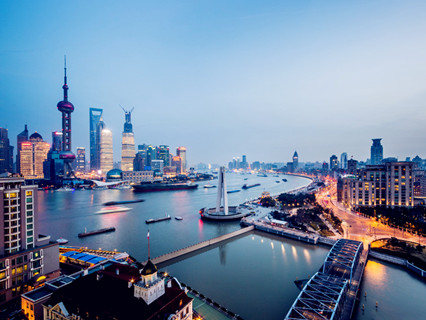
Larger than Shanghai itself, the Pudong Mew Area is on the eastern bank of Huangpu River. Before 1990,when development plans were first announced. Pudong constituted 350 sq km of boggy farmland supplying vegetables to Shanghai’s markets. Now the veggies are grown elsewhere as Pudong has become a Special Economic Zone (SEZ).


Shanghai’s second metro line opened at the end of 1999 and connects Pudong with Puxi. The Waigaoqiao harbor area is being upgraded into a major container port and the US$ billion Pudong International Airport opened as the main international airport in late 1999.
Nanjing Road


Nanjing Road


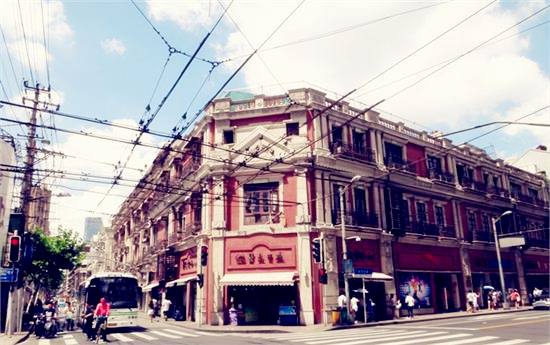
Nanjing Donglu, from the Peace to the Park hotels, has long seen China’s golden mile, though its glamour has slipped a few notches in the last 15 years. Hoping to bring back its former glory, the city began a massive renovation project in the late 1990s, turning Nanjing Lu into a pedestrian-only shopping extravaganza from Xizang Lu to Henna Lu.


Nanjing Donglu becomes Nanjing Xilu at Renmin Gongyuan (People’s Park ). The park and the adjacent People’s Square were once the site of the Shanghai Racecourse, mow occupied by the Shanghai Museum, the Shanghai Grand Theatre, the Shanghai Urban Planning Exhibition Hall and the rather drab municipal government building. Nanjing Xilu itself was previously Bubbling Well Rd, the natural spring having been long sealed over.


The crowds are less intense as you head west along Nanjing Xilu, past the former Shanghai Race Club and previous site of the Shanghai Library, now the Shanghai Art Gallery. Beyond the Chengdu Lu Expressway, which cuts down the centre of Shanghai, Nanjing Xilu gives way to office blocks and more shops and hotels, all of which join forces in the impressive Shanghai Centre and Soviet-era Shanghai Exhibition Centre opposite.


Pudong New Area

Oriental Pearl TV Tower

Tower1


Oriental Pearl TV Tower


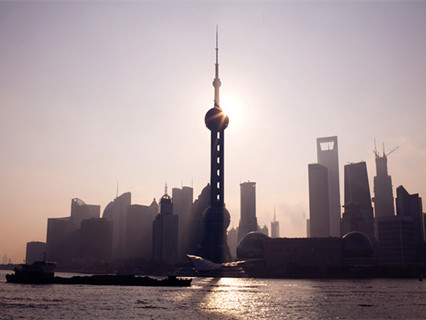
Shanghai Oriental Pearl TV Tower was completed on Oct. 1, 1994. It is 468 m high, being the highest in Asia and the third highest in the world, only next the TV towers in Toronto in Canada and Moscow in Russia. It stands opposite to the bund on the west bank.. The architectural modeling of the tower is unique, expressing the flavor of oriental culture. The structure of the tower consists of 11 spheres, different in sizes and arranged at different levels, hanging from the sky down to the green lawns. It expresses the artistic concept of “pearls, big and small, dropping on a jade plate”. The body of the tower is formed of two huge glittering spheres and one small delicate sphere; the sightseeing level in the upper sphere is 45 m in circumference, 263 m high, offering a bird’s-eye view of the city. In the upper sphere at the 267-m level, there is a revolving restaurant, with one revolution every hour, a disco ball, a piano accompanied bar and at the 271-m level there are 20 KTV private rooms. The space cabin is at a level of 350 m, containing a sightseeing terrace, a meeting hall and a coffee room. Hotel in the Air is in the five smaller sphere with 20 guest rooms. The lower sphere contains a space city. There is a science fiction city inside the tower pedestal.


tower3


The Oriental Pearl TV Tower combines sightseeing, catering, shopping, recreation, accommodation, broadcasting and TV transmission into one body. It has become a symbolic architecture and a favorable spot for tourists in Shanghai. The Oriental Pearl Tower is 468 meters high, the highest TV tower in Asia and the third highest in the world. The Oriental Pearl Tower consists of three main whole-scope sightseeing floors. Tourists can enjoy the dynamic city view of different height. The Space Module is at the height of 350 meters; the highest revolving restaurant in Asia is at 267 meters; the main sightseeing floor is at 263 meters; you also can go outside at 259 meters and 90 meters. Located at the lobby of the Oriental Pearl Tower is “Shanghai’s Urban Development History Museum”. It consists of six halls: “Transportation exhibition” “Overview of the old city” “The architectural Landscape of Shanghai at the Beginning of the 20th century” “The Metropolis infested with foreign adventures” “Traces of Old Shanghai” “Architectures Exhibition”. The cruise sightseeing on the Huangpu River is the new item of the Oriental Pearl Tower. Taking the luxurious cruise, you can enjoy fantastic scenes of both sides of the river.


Tower2


Oriental Pearl TV Tower

The Bund

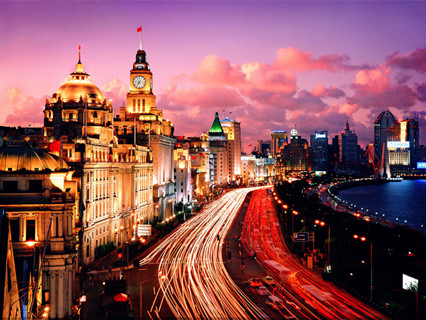
The Bund is waterfront area in central Shanghai, The area centers on a section of Zhongshan Road within  the former Shanghai International Settlement, which runs along the western banks. of Huangpu River , facing Pudong, in the eastern part of Huangpu District. It is one of the most famous tourist destinations in Shanghai.


The Bund trench one mile along the bank of huangpu River. Traditionally, the Bund begins at Yan’an Road in the south and ends at Yan’an Road in the south and ends at Waibaidu Bridge in the north, which crosses Suzhou Creek.


The Bund centers on a trench of the Zhongshan Road, name after Su Yat-sen, Zhongshan Road is a largely circle road which formed the traditional conceptual boundary of Shanhai city” proper”. To the west of this stretch of the road stands some 52 building of various western classical and modern style which is the main feature of the Bund.


The Bound houses 52 buildings of various architectural style, generally Eclecticist,  but with some buildings displaying predominantly Romanesque Revival, Gothic Revival, Renaissance Revival, Baroque Revival, Neo-classical Revival or Beaux-Arts styles, and a number in Arts styles, and a number in Art Deco style(Shanghai has one of the richest collections of Art Deco architectures in the world.)


bund1


To the European, the Bund was Shanghai’s Wall Street, a place of feverish trading, of fortunes made and lost. One of the most famous traders was Jardine Matheson & Company. In 1848 Jardine’s purchased the first land offered for sale to foreigners in Shanghai and set up shop shortly after, dealing in opium and tea. The company grew into one of the great hongs (a hong is literally a business firm), and today it owns just about half of Hong Kong.


he Bund today is in the process of yet another transformation. The building identified by a crowning dome is the old Hongkong & Shanghai Bank, completed in 1921 with much pomp and ceremony. For many years it housed the Shanghai People’s Municipal Government and was off-limits to curious travelers. Now it belongs to the Pudong Development Bank and you can take a look inside the magnificent central hall during business hours. Other Bund fixtures have also been fixed up and newly occupied by domestics and foreign companies.


There are many snacks and restaurants near the Bund, such as the Beer restaurant, the Italy restaurant, the seafood hot pot and so on.


bund2


The Bund

beijing car11

Suitable for 1~3 passengers with normal luggage
VW Passat or Toyota Camry


5 seats air conditioned car, with professional driver.


We provide following services for car rental in Beijing.


  • Airport pick-up/drop-off: Pick up from Beijing Airport to your hotel, you need provide your flight number and arriving time, our driver will wait for you at the Arrival Exit.

  • Half day Rental: Limit: 4 hours, 50 kilometers. Not including airport transfers.

  • Full day Rental: Limit: 8 hours, 100 kilometers.

  • Badaling Great Wall: 8 hours, pick up from your hotel to the Great Wall and drive back to hotel.

  • Mutianyu Great Wall: 8 hours, pick up from your hotel to the Great Wall and drive back to hotel.

  • Simatai/Jingshanling Great Wall: 8 hours, pick up from your hotel to the Great Wall and drive back to hotel.

  • Tianjin Cruise Port Transfer: Pick up the cruise tourists from Tianjin Port to Beijing City, or vise verse.


beijing car11

Sony ExploraScience

Sony ExploraScience has a range of interactive displays appealing to kids of all ages, including robotic dogs who play soccer, musical sculptures, sound and light distortion machines, soap bubble rings and much more. All the exhibits are interactive and range from educational (a guitar which teaches children about sound waves as they pluck it), to downright fun (blue rooms, which will pose you against iconic China backdrops). Better still, on entering the museum, you’re provided with an e-card. Swipe your card in the computer terminals by each display and the screens explain in your chosen language how to interact with the exhibits. For those who understand Mandarin, there is also a 3D film theatre to enjoy and regular science shows throughout the day, with actors conducting fun experiments.


Sony ExploraScience